
Last updated: 4 May 2026
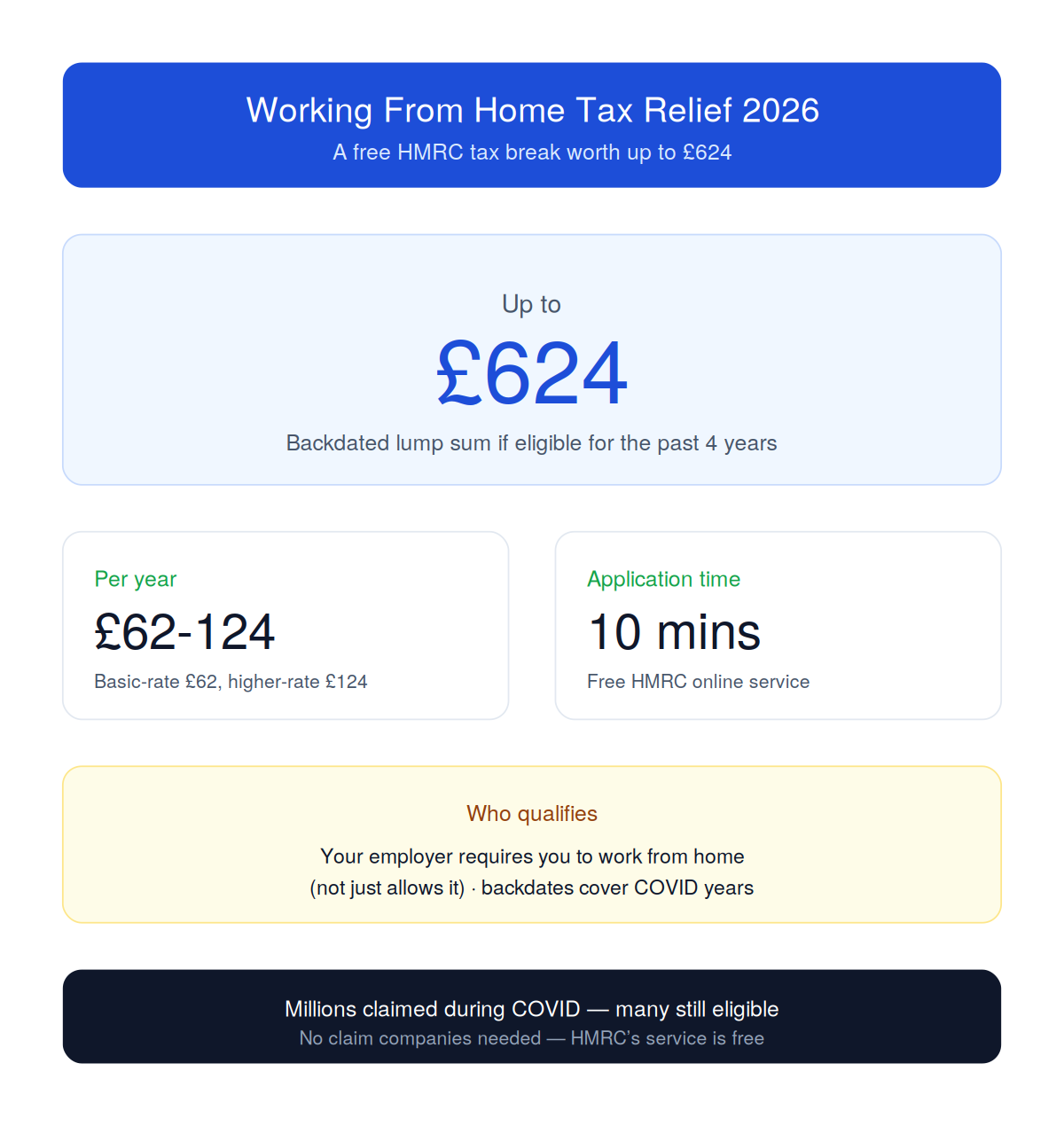
Working from home tax relief is a free HMRC tax break worth up to £624 if you’ve been required to work from home over the past four tax years. The blanket COVID-era version was scrapped, but the relief itself still exists — and millions of eligible UK workers have never claimed it.
If you currently work from home (or did during 2022/23 onwards) because your employer requires it, HMRC owes you tax back. You can backdate working from home tax relief by up to four tax years, the application takes about ten minutes online, and it’s completely free.
This guide explains who still qualifies for working from home tax relief in 2026, exactly how much you can claim, and how to apply directly to HMRC without paying a refund company a penny.
What is working from home tax relief?
Working from home tax relief is an allowance from HMRC that covers the additional household costs you incur when you have to work from home — things like extra electricity, gas, water, and business phone calls.
It’s not a refund of your bills. It’s a tax deduction. HMRC adjusts your tax code so you pay less income tax, and any backdated claim is paid as a lump sum directly into your bank account.
The current flat rate for working from home tax relief is £6 per week (£312 per tax year). At the basic 20% tax rate, that puts £62 a year back in your pocket. At the higher 40% rate, it’s £124 a year. Backdated four years, that’s £248 to £496 — and on top of that, your tax bill drops going forward.
Who qualifies for working from home tax relief in 2026?
Here’s where things changed. From April 2022, HMRC tightened the rules. To claim working from home tax relief now, all of the following must be true:
- Your employer specifically requires you to work from home (not just allows or encourages it)
- Your job involves duties you can only perform at home, OR your employer has no appropriate office space
- You incur additional household costs as a direct result
- Your employer doesn’t already reimburse you for these costs (most don’t)
The key phrase is “requires.” A hybrid worker who chooses to work from home two days a week doesn’t qualify. A fully remote worker whose employment contract specifies home-based working does. Same goes for anyone whose employer doesn’t have an office, or whose office is too far away to reasonably commute to.
To claim working from home tax relief for backdated years, the same rule applies — but for 2020/21 and 2021/22 specifically (the COVID years), HMRC was more flexible. If you were told to work from home during lockdown, you can still claim those years.
What if I’m a hybrid worker?
Pure hybrid workers (where the employer offers an office but allows home working) generally don’t qualify for working from home tax relief any more. The exception is if your contract specifically says you must work from home for a portion of the week — in which case you can claim a proportion.
How much is working from home tax relief worth?
There are two ways to calculate working from home tax relief: the simple flat rate, or actual costs.
1. The flat-rate method (recommended for most people)
HMRC lets you claim £6 per week without any receipts or bills as evidence. That’s £312 per tax year. Your refund is that amount multiplied by your tax rate:
- Basic rate (20%): £62 per year
- Higher rate (40%): £124 per year
- Additional rate (45%): £140 per year
Backdated four years, that’s potentially £248 to £560.
2. The actual costs method
If your additional household costs are higher than £6 a week, you can claim the actual amount — but you’ll need bills, calculations showing the work-related portion, and patience. For most workers, the flat rate is simpler and the difference isn’t worth the paperwork.
How to claim working from home tax relief — the free way
The working from home tax relief claim is made directly to HMRC, with no third-party involvement needed.
1. Online (fastest)
Go to the official GOV.UK service: Claim tax relief for working at home. You’ll need a Government Gateway login. The form takes about ten minutes.
You’ll be asked:
- What dates you worked from home for
- Whether your employer required it
- Whether your employer reimbursed any costs
- How many weeks you’re claiming for
2. Through your Self Assessment return
If you fill in a Self Assessment tax return, you can claim working from home tax relief directly on the form under “Employment expenses.” HMRC adjusts your bill automatically.
3. By post (form P87)
Download form P87 from GOV.UK, fill it in, and post it to: Pay As You Earn, HM Revenue and Customs, BX9 1AS. No stamp needed. Use this route if you want to claim several different work expenses at once.
What happens after you apply?
Once HMRC processes your working from home tax relief claim:
- Your tax code changes — usually with a small adjustment to reflect the new allowance
- Any backdated refund is paid as a lump sum, by cheque or bank transfer, within 6 to 8 weeks
- Your future tax bill drops automatically as long as the relief stays in place
You don’t need to reapply every year — but if your circumstances change (you go back to the office, switch to hybrid, or change employers), you should let HMRC know. Otherwise, they may continue applying the relief and ask for the money back later.
Don’t pay a “tax refund company” for this
Several refund firms advertise working from home tax relief claims, charging 30–50% of any refund as their fee. Some also use cold text messages or social media ads to target office workers.
For a £496 backdated claim, that’s up to £248 in fees — for ten minutes of work that you can do for free. HMRC’s own service is genuinely simple, the form is short, and the refund goes directly to you.
Working from home tax relief is one of the easiest tax claims to do yourself. There’s no scenario in which paying a third party makes sense.
What if my employer pays me a working-from-home allowance?
Some employers pay a tax-free allowance of up to £6 per week towards home working costs. If yours does, you can’t also claim working from home tax relief on top — the £6 is already going to you tax-free.
If your employer pays less than £6 per week, you can claim the difference from HMRC. And if they pay nothing at all, you can claim the full amount — which is the most common scenario.
Quick checklist before you apply
Before you claim working from home tax relief, run through this short checklist:
- Are you required by your employer to work from home (not just allowed)?
- Do you have additional household costs as a result?
- Has your employer not reimbursed those costs?
- Did you pay income tax in the years you’re claiming for?
- Have you been eligible during any of the past four tax years (2022/23 onwards)?
Tick all five and you’re eligible. Even if you’re only eligible for some of the past four years, you can still claim a partial backdated refund.
Try our free working from home tax refund calculator
Not sure exactly how much working from home tax relief you might be owed? Use our free Working From Home Calculator to get an instant estimate based on how many years you can backdate. No sign-up, no email — runs entirely in your browser.
Last updated: April 2026 (for the 2026/27 tax year). This guide is for general information only and not personal tax advice. For HMRC’s official guidance, see gov.uk/tax-relief-for-employees/working-at-home.