
Last updated: 30 April 2026
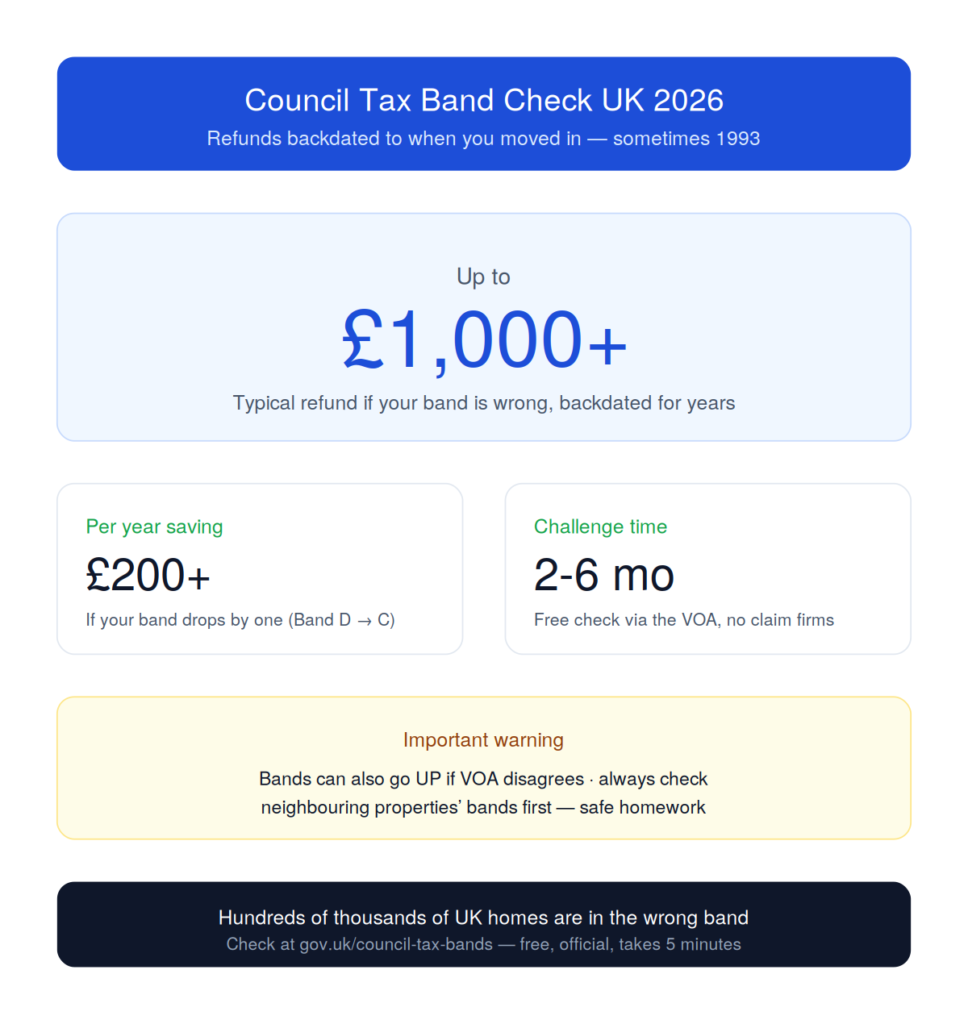
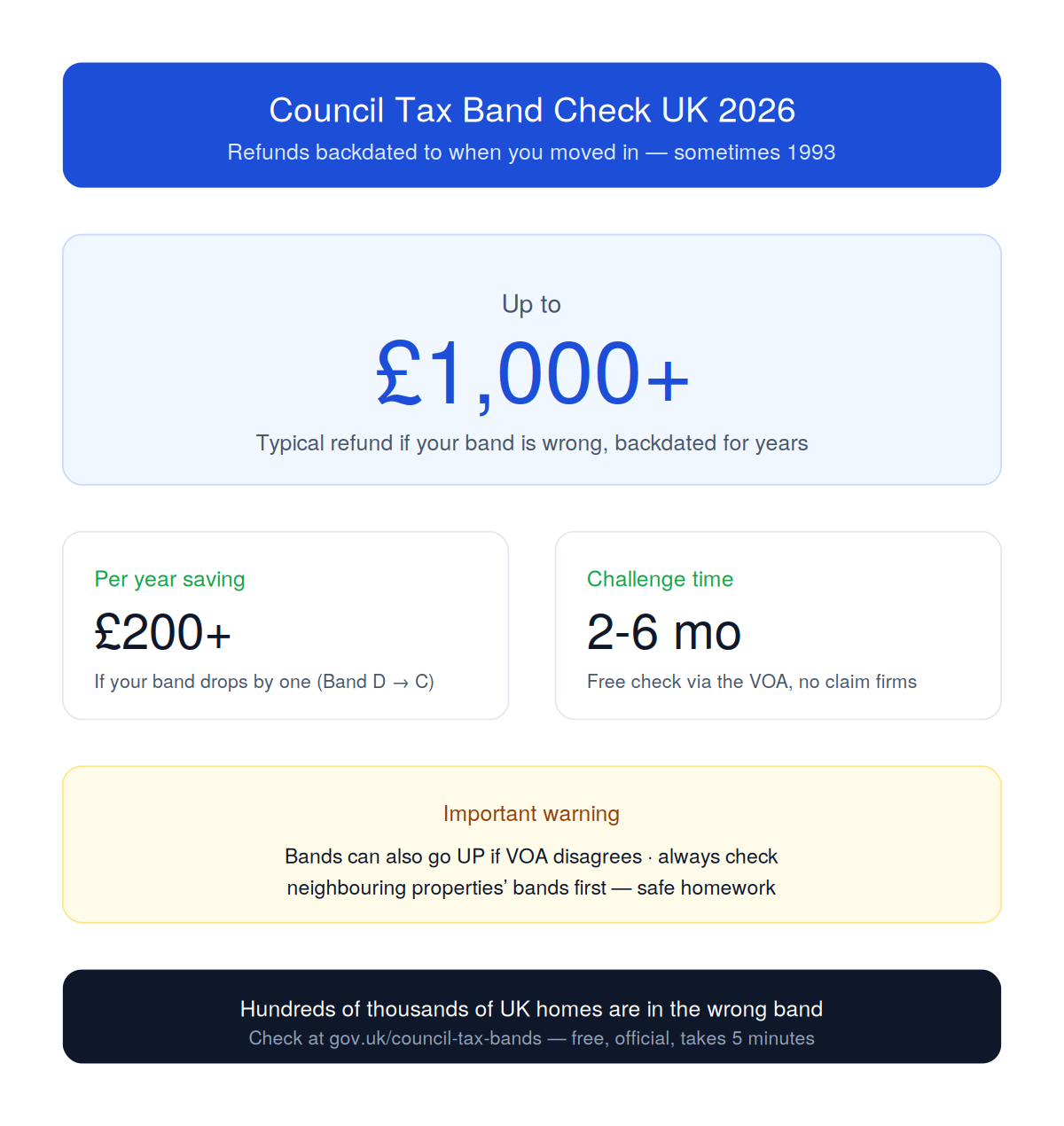
A council tax band check is the simplest way to find out if you’ve been overcharged for years — sometimes decades. Hundreds of thousands of UK homes are in the wrong council tax band, and successful challenges can be backdated all the way to 1993 when the bands were first set.
Refunds of £1,000 to £5,000+ aren’t unusual. The check itself is free, takes five minutes, and can be done directly via the Valuation Office Agency (VOA) without involving any third-party “claim companies.” But there’s also a real risk you need to understand first — your band could go up instead of down.
This guide explains how to do a safe council tax band check in 2026, what to look for, when it’s worth challenging, and exactly how to claim a backdated refund if you’re successful.
What is a council tax band check?
A council tax band check is a comparison of your home’s council tax band against (a) the bands of similar neighbouring properties, and (b) what your home would have been worth in April 1991 — the date the bands were originally set in England and Scotland (April 2003 for Wales).
If your band is higher than it should be, you’ve been paying too much council tax — potentially for decades. The Valuation Office Agency (VOA) can review your band, and if they agree it’s wrong, your council tax bill drops going forward and you receive a refund of the overpayment, sometimes backdated to the day you moved in.
The reason this is so common: when bands were first set in 1991, the valuations were rushed. Estate agents drove around streets making rapid judgements, and many homes ended up in the wrong band on day one. Decades later, those errors are still in place.
How to do a safe council tax band check
The single most important rule of a council tax band check: do your homework before you challenge. The VOA can decide your band should go UP, not down. So you want strong evidence that you’re overpaying before you ask them to look.
Step 1: Find your band
Go to gov.uk/council-tax-bands and enter your postcode. Your band (A through H in England, A through I in Wales, A through H in Scotland) is shown.
Step 2: Check your neighbours’ bands
This is the most important part of any council tax band check. The same GOV.UK tool lets you check every property’s band on your street.
Look at properties that are genuinely similar to yours — same street, same size, same age, same type (terrace, semi, detached). If most are in a lower band than you, you have a strong case. If they’re all the same band as you, your band is probably correct.
Be careful: don’t compare with a flat if you live in a house, or with an extended property if yours is original. Like-for-like is everything.
Step 3: Do the 1991 valuation check
This is where the council tax band check gets technical. Bands are based on what the property was worth in April 1991, even if you bought it in 2026. To estimate your 1991 value:
- Find what your property is worth today (Rightmove sold prices, Zoopla, or a recent valuation)
- Use the Nationwide House Price Calculator (search online) to convert today’s value back to 1991 prices
- Compare against the official 1991 band thresholds
The 1991 band thresholds for England are:
- Band A: Up to £40,000
- Band B: £40,001 – £52,000
- Band C: £52,001 – £68,000
- Band D: £68,001 – £88,000
- Band E: £88,001 – £120,000
- Band F: £120,001 – £160,000
- Band G: £160,001 – £320,000
- Band H: Over £320,000
If your estimated 1991 value falls in a lower band than your current band — and your neighbours’ bands support that — you’ve got a strong council tax band check result and grounds for a challenge.
How much can a successful challenge save you?
A successful council tax band check that drops your band by one (e.g. Band D → Band C) typically saves £200–£300 a year, depending on your council. Backdated to when you moved in:
- 5 years in the property: roughly £1,000–£1,500 refund
- 10 years: £2,000–£3,000 refund
- 20+ years: potentially £5,000+ refund
And the savings continue going forward. A successful council tax band check is one of the most valuable single financial wins available to UK homeowners — especially in older homes where the original 1991 valuations were rushed.
The important warning: bands can go UP
This is why a careful council tax band check matters before you challenge.
If you ask the VOA to review your band and they look at your property in detail, they may decide your band should be HIGHER, not lower. In that case, your council tax bill goes up — and they can backdate the increase, leaving you with a bill for years of underpayment.
This is most likely if:
- You’ve extended the property (loft conversion, extension)
- You’ve significantly improved it (added bedrooms, bathrooms)
- Your home is in an unusually high band area but you’re at the bottom of it
- The improvements were made before you bought the property and weren’t picked up by the VOA
If your home has been improved or extended since 1991, do the maths very carefully before challenging. A council tax band check that triggers an upward revaluation can cost you thousands.
How to challenge your council tax band
If your council tax band check has produced strong evidence that your band is wrong, here’s how to challenge it.
1. Make a formal proposal (England and Wales)
Go to gov.uk/challenge-council-tax-band. You can challenge online if:
- You moved into your home within the last six months, OR
- Your local area has had bands changed recently, OR
- The property has changed (knocked down, partly demolished, etc), OR
- You believe the original valuation was wrong
If none of those apply, you can still write to the VOA informally with your evidence — many band corrections happen this way without a formal challenge.
2. Provide your evidence
Include in your submission:
- Comparable neighbouring properties in lower bands
- Your 1991 valuation calculation
- Any other relevant context (e.g. property defects)
3. Wait for the decision
The VOA usually takes 2 to 6 months. They may visit the property or rely on photographs and records. If they agree, your band is changed and your council issues a refund automatically.
Scotland
In Scotland, council tax band checks are handled by the Scottish Assessors. Process is similar — go to saa.gov.uk and look up your property to start.
What happens if your challenge succeeds?
Once your council tax band check challenge succeeds:
- The VOA writes to your council with the new band
- Your council adjusts your future bills automatically
- The refund of overpaid tax is calculated and sent — usually as a cheque or bank transfer, sometimes credited against future bills
- The new band stays in place unless circumstances change
If your neighbours are also in the wrong band, your successful challenge may trigger them to be reviewed. This isn’t always the case — but it’s worth letting neighbours know they may also benefit.
Don’t pay a “band check” company
Some firms advertise council tax band checks and challenges, charging fees of 30–50% of any refund. Some also charge upfront fees regardless of outcome.
The entire process — checking your band, comparing neighbours, doing the 1991 calculation, and submitting a challenge — is free at GOV.UK and the VOA. There’s no specialist knowledge required, and the VOA isn’t more likely to listen to a paid firm than to you.
A council tax band check costs nothing and takes 5 minutes. Don’t pay anyone for something this simple.
Quick checklist before you challenge
Before submitting a council tax band check challenge, run through this:
- Have I checked my neighbours’ bands and found similar properties in lower bands?
- Have I done a 1991 valuation calculation that supports a lower band?
- Has my home been extended or significantly improved since 1991?
- Am I prepared for the band to potentially go UP if I’m wrong?
If you’re confident in points 1 and 2, and points 3 and 4 don’t pose a risk, you have grounds for a strong council tax band check challenge.
Try our free council tax band check calculator
Not sure if your band is wrong? Use our free Council Tax Band Check Calculator to compare your home against neighbouring properties and estimate your 1991 valuation. No sign-up, no email — runs entirely in your browser.
Last updated: April 2026 (for the 2026/27 tax year). This guide is for general information only and not personal tax or legal advice. For HMRC and VOA’s official guidance, see gov.uk/challenge-council-tax-band.