
Last updated: 4 May 2026
A mileage allowance refund is owed to most UK employees who use their own car, motorbike, or bicycle for work journeys — and whose employer pays less than HMRC’s official rate of 45p per mile. If that’s you, you’re probably owed money.
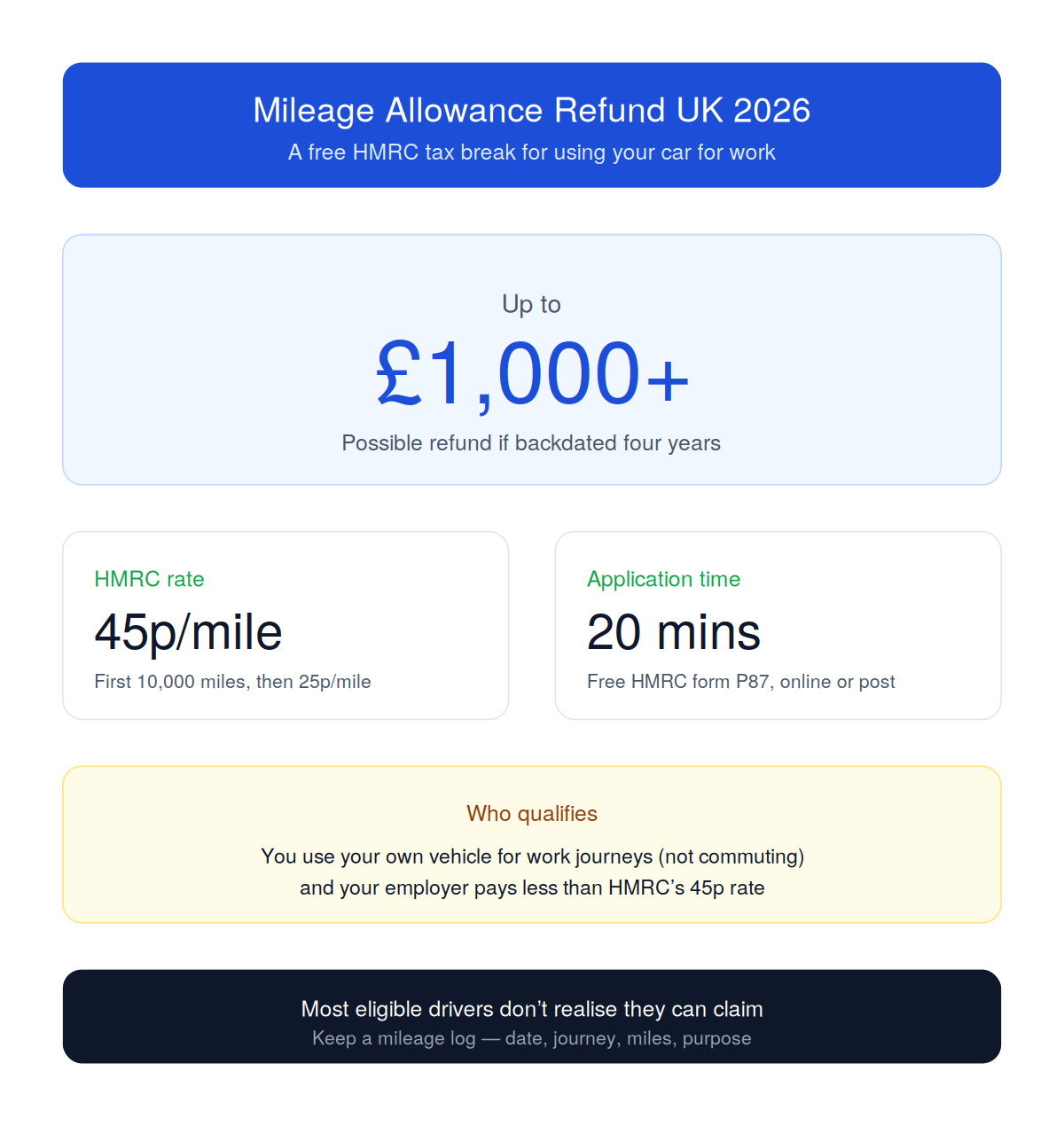
Backdated four years, the typical mileage allowance refund runs into the hundreds. For higher-mileage workers — sales reps, engineers, healthcare staff, tradespeople — it can exceed £1,000. The application takes 20 minutes via HMRC’s free P87 form, and there’s no need to use a refund company.
This guide explains exactly who can claim a mileage allowance refund in 2026, how the calculation works, and how to file the claim directly to HMRC for free.
What is the mileage allowance refund?
The mileage allowance refund (also called Mileage Allowance Relief, or MAR) is HMRC’s way of compensating employees who use their own vehicle for work but don’t get reimbursed at HMRC’s full approved rate.
HMRC sets an “approved mileage rate” — currently 45p per mile for the first 10,000 business miles, then 25p per mile beyond that. If your employer pays you less than that rate (or nothing at all), you can claim the difference back as tax relief on the shortfall.
It’s not a cash refund of the mileage itself. It’s a refund of the income tax you’ve paid on income you should have been reimbursed for. So a basic-rate (20%) taxpayer gets back 20% of the shortfall, and a higher-rate (40%) taxpayer gets back 40%.
Who qualifies for a mileage allowance refund?
You qualify for a mileage allowance refund if all of the following are true:
- You use your own vehicle (car, van, motorbike, bicycle) for work journeys
- The journeys are business travel — not your normal commute
- Your employer pays less than 45p per mile (or 25p after the first 10,000 miles)
- You paid income tax in the year you’re claiming for
The most important distinction: commuting to your normal place of work doesn’t count. Mileage allowance refund covers journeys to a temporary workplace, between work sites, to client premises, or to training courses.
“Temporary workplace” is the key tax phrase. Generally, this means a workplace you go to for less than 24 months — for example, a project site, a training venue, or a client’s office.
Common situations that qualify
- Sales reps driving between client meetings
- Tradespeople driving between job sites
- Healthcare staff driving between patient homes or NHS sites
- Engineers visiting different installation sites
- Office workers occasionally driving to client meetings or training
- Anyone whose employer rotates them between multiple workplaces
How much is a mileage allowance refund worth?
The mileage allowance refund is calculated as the gap between HMRC’s approved rate and what your employer actually paid, multiplied by your tax rate.
HMRC’s approved rates
| Vehicle | First 10,000 miles | Above 10,000 miles |
|---|---|---|
| Car or van | 45p per mile | 25p per mile |
| Motorcycle | 24p per mile | 24p per mile |
| Bicycle | 20p per mile | 20p per mile |
Worked example
You drive 8,000 business miles in a year. Your employer pays you 25p per mile.
- HMRC rate: 8,000 × 45p = £3,600
- Employer paid: 8,000 × 25p = £2,000
- Shortfall: £1,600
- Tax relief at 20%: £320
- Tax relief at 40%: £640
Backdated four years at the same mileage, that’s a mileage allowance refund of £1,280 (basic rate) or £2,560 (higher rate).
What records do I need?
HMRC requires evidence of your business mileage. You don’t need to submit it with your claim, but they may ask for it later (and you must keep it for at least 22 months after the end of the tax year).
A proper mileage log includes:
- Date of each journey
- Start and end points
- Purpose of the journey
- Number of miles driven
- Vehicle used
If you don’t have a formal log, you can usually reconstruct one from calendar entries, expense claims, emails, and receipts (e.g. fuel receipts, parking tickets at client sites). Be conservative — if you can’t reasonably justify a journey, don’t claim it.
How to claim a mileage allowance refund
A mileage allowance refund is claimed using HMRC form P87 — the same form used for uniform tax rebates and other employment expenses.
1. Online (fastest)
Go to gov.uk/tax-relief-for-employees and follow the link to claim online. You’ll need a Government Gateway login. The form takes about 20 minutes.
You’ll be asked:
- The tax year(s) you’re claiming for
- Your total business mileage
- What your employer reimbursed you
- The vehicle you used
2. By post
Download form P87, complete it, and post to: Pay As You Earn, HM Revenue and Customs, BX9 1AS. No stamp needed. Useful if you’re claiming several different expenses at once.
3. Through Self Assessment
If you fill in a Self Assessment tax return, you can claim mileage allowance refund directly under “Employment expenses.” This is the route most higher-rate taxpayers use.
What happens after you apply?
Once HMRC processes your mileage allowance refund:
- Your tax code may be adjusted to reflect the relief going forward
- Backdated refunds are paid as a lump sum within 6 to 8 weeks
- If you continue to incur the same mileage costs, the relief continues automatically
If your circumstances change — you stop using your own vehicle, change jobs, or your employer starts paying the full HMRC rate — let HMRC know so they can update your tax code.
Don’t pay a refund company for this
“Mileage refund specialists” advertise this service heavily, taking 30–40% of any refund. For someone owed £1,000, that’s £300+ in fees for filling in a form that asks for your job, your mileage, and your employer’s pay rate.
The mileage allowance refund process is genuinely simple. HMRC’s form is short, the calculation is just basic arithmetic, and the refund goes directly to your bank account. There’s no scenario where paying a third party makes sense.
Common mistakes to avoid
When filing a mileage allowance refund claim, avoid these errors:
- Claiming for commuting: Your normal home-to-office journey doesn’t count, ever
- Round-tripping past your normal workplace: If you drive past your normal office to a client, you can only claim the extra distance
- Inflating mileage without records: If HMRC asks for evidence and you can’t produce it, your claim will be rejected and you may face penalties
- Mixing personal and business journeys: Be honest about which journeys are which
- Claiming for company car drivers: If you have a company car, mileage allowance refund doesn’t apply — different scheme
Quick checklist before you apply
Before you start your mileage allowance refund claim, run through this:
- Did you use your own vehicle for work journeys (not commuting)?
- Did your employer pay less than 45p per mile?
- Do you have a mileage log or evidence (calendar, expenses, emails)?
- Did you pay income tax in the year you’re claiming for?
- Have you been eligible in any of the last four tax years?
If you tick all five, you’re eligible for a mileage allowance refund, potentially backdated four years.
Try our free mileage allowance refund calculator
Not sure how much you might be owed? Use our free Mileage Allowance Calculator to get an instant estimate based on your annual mileage and what your employer pays you. No sign-up, no email — runs entirely in your browser.
Last updated: April 2026 (for the 2026/27 tax year). This guide is for general information only and not personal tax advice. For HMRC’s official guidance, see gov.uk/tax-relief-for-employees.